The Vietnam War waged from 1961 – 1975 and American battle deaths reached 47,410.
The Iraq War waged from 2003 – 2011 and American battle deaths reached 4,487.
In one year the CDC estimated “that 1.7 million hospital patients become infected each year, causing or contributing to the deaths of nearly 100,000 people.”

This, believe it or not, indicated some improvement since 2000-2002 when “an average of 195,000 people in the USA died due to potentially preventable, in-hospital medical errors in each of the years 2000, 2001 and 2002, according to a new study of 37 million patient records that was released today by HealthGrades, the healthcare quality company.”

To try to stop this carnage in American hospitals, the Institute for Healthcare Improvement (IHI) began a campaign to save 100,000 Lives. IHI engaged over 3000 US hospitals (representing over 80% of total US hospital discharges) from January 2005 to June 2006 in its campaign to avoid 100,000 unnecessary deaths by adopting six evidence based interventions:
-
Deploy rapid response teams to patients at risk of cardiac or respiratory arrest
-
Deliver reliable, evidence based care for acute myocardial infarction
-
Prevent adverse drug events through drug reconciliation (reliable documentation of changes in drug orders)
-
Prevent central line infections
-
Prevent surgical site infections
-
Prevent ventilator associated pneumonia.
“The campaign estimates that, as of April 2006, participating hospitals had saved over 84 000 lives (based on 83% of participating hospitals submitting mortality data).”
The results so encouraged IHI that it went on to start the 5 Million Lives Campaign. IHI reported Hospitals participating in the Campaign had not only significantly reduced their monthly hospital acquired infection (HAI) rates, in some months all the way down to zero, but “a surprising number were getting down to zero and staying there.”
“If we could focus our efforts on just four key areas –
-
failure to rescue,
-
bed sores,
-
postoperative sepsis, and
-
postoperative pulmonary embolism – and
-
reduce these incidents by just 20 percent, we could save 39,000 people from dying every year,” said Dr. Collier, VP of HealthGrades.
Thus armed with American facts I tried to obtain similar studies about the hospitals in the Caribbean but could find none. However, as the WHO map below shows, Latin America is a hotbed of untreatable Staph. aureus infections so avoid hospitals wherever you go.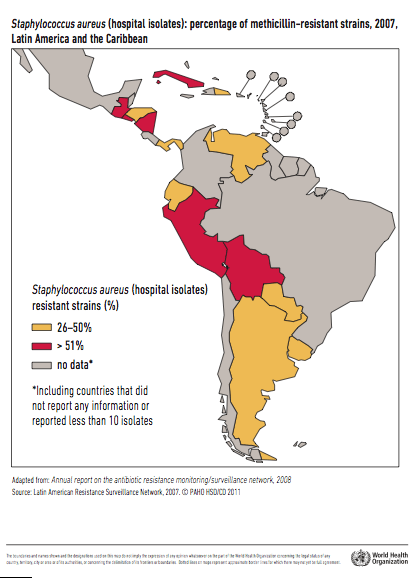
 Saving A Life
