Do you know what’s the biggest problem facing Barbados? Obesity.
Do you know what’s the biggest problem facing the USA? Obesity.
Do you know what’s the biggest problem facing Dominica? Obesity.
According to Forbes magazine, the Fattest Countries in the world are:
Rank
|
Country
|
%
|
1.
|
Nauru
|
94.5
|
2.
|
Micronesia
|
91.1
|
9.
|
United States
|
74.1
|
11.
|
Dominica
|
71.0
|
12.
|
Barbados
|
69.7
|
20.
|
Trinidad & Tobago
|
|
In the US,
-
One third of the population is of Normal weight.
-
One third of the population is Overweight.
-
One third of the population is Obese.
-
In other words, ~100 million Americans are obese.
-
79 million are prediabetic.
In Barbados,
-
55.8% of adult men are overweight/obese.
-
63.8% of women are overweight/obese.
HOW MUCH DOES OBESITY COST?
The World Health Organization (WHO) claims that Barbados spent 6.7% of GDP on Health in 2008 but the Barbadian government claimed it spent 14% in 2001/2002, which would place it 2nd behind the USA.
Rank
|
Country
|
Total Health Expenditure per capita PPP Int. $
|
T.H.E. % of GDP
|
1
|
United States
|
7,164
|
15.2
|
41
|
Barbados
|
1,498
|
6.7
|
46
|
Trinidad & Tobago
|
1,237
|
4.7
|
WHO WILL BE LEFT TO TAKE CARE OF THE FAT TWO THIRDS?
In Barbados,
-
from 2000 to 2005, the number of nurses fell from 922 to 900;
-
from 1995 to 2005, the number of Radiographers fell from 30 to 12;
-
Lab technologists number fell from 49 to 2.
-
Do you see where things are headed?
WHAT ABOUT OUR CHILDREN? ARE THEY GETTING FAT TOO?
“The problem of childhood obesity in the United States has grown considerably in recent years. Between 16 and 33 percent of children and adolescents are obese.” American Academy of Child and Adolescent Psychiatry.
A 2008 study has found that children who are obese have carotid arteries which have prematurely aged by as much as thirty years as well as abnormal levels of cholesterol.

‘As Anna Busby says, based on her observations as the nurse of the Bogalusa Middle School Health Clinic, (Louisiana) overweight and obese children are at risk of being “on dialysis in their thirties if we don’t do something now.”
SO WHAT CAN WE DO?
Herein lies a huge problem. The Health Care industry only gets paid to care for sickness, not for wellness. So the hospitals and providers stand waiting for you to fall sick and then they get into motion so they will wait decades for us to come down with diabetes etc. In the meantime, it’s up to us to look after each other. We have to try to prevent the diseases of obesity such as diabetes, heart attacks, strokes and cancer.
Fortunately, some providers have taken wellness to heart and built their whole approach around it. One such organization is Kaiser Permanente which came into being during the Depression precisely to keep workers healthy so that they could build the Grand Coulee Dam and then America’s navy and then turned to American workers in general.
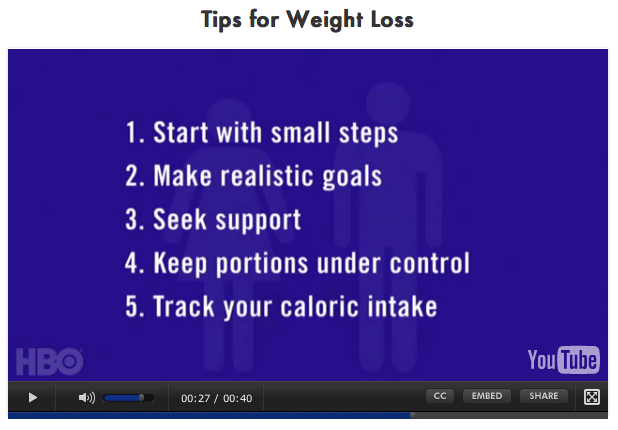
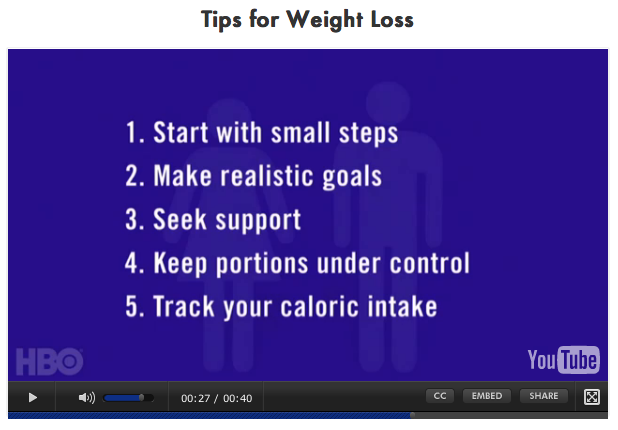
Well Kaiser Permanente, the Institute of Medicine, the CDC and Dell Corporation got together with HBO to produce a series of Videos to document the problem of Obesity and point out solutions. Among the many facts you will learn there are that:
Sugary drinks are a major source of calories for children ages 2-18.
One 20-oz. bottle of regular soda has about 14 teaspoons of sugar. That’s more sugar than two candy bars.
Consumers spend the biggest share of their food dollars on sugar, sweets, fats and oils, non-alcoholic beverages, and many prepared foods.
Where do our kids get their meals?
-
Studies show that 20% of students eat breakfast,
-
40% have a snack and
-
90% eat lunch at school.
But School Lunches are Not as Healthy as You think:
-
When the USDA last surveyed parents to find out what they thought about the quality of school food, 88.9% believed the food was very or somewhat healthy.
-
The same USDA study found that 94% of schools served a lunch that failed to meet USDA standards for healthy school meals.
On average, U.S. adults spend nearly 20 hours a week watching TV. Fewer than half of  them get the recommended 2.5 hours of weekly moderate-intensity activity. Move more, sit less. Replacing sedentary time with active time can help you lose weight and improve your health.Taking just 1,000 more steps every day could add up to almost 200 miles in a year.Adults who walk more tend to gain less weight. Find easy ways to build more steps into your day.
How to Replace Sitting Time with Active Time
-
While you’re watching TV, march in place or do other activities that make your heart beat faster.
-
Instead of relaxing by watching TV, take a walk!
-
Dance to your favorite songs.
-
Take the stairs instead of the escalator or elevator.
-
After a meal, take a walk instead of watching TV.
-
At work, take a break by walking around your building. Two times around would be even better.
-
Stand or walk while talking on the phone or reading emails.
http://www.ctv.ca/CTVNews/TopStories/20081111/kids_arteries_081111/
http://www.aacap.org/cs/root/facts_for_families/obesity_in_children_and_teens
Question: Would you try to find out the DNA genome of a newborn child?
Before you answer, let me tell you about Alexis and Noah, twins diagnosed at age two with cerebral palsy – at least that’s what their doctors thought.
Their mother, however, refused to accept their opinion. Over the next three years, she did her own research which led doctors to change the diagnosis to DRD – Dopa-Responsive Dystonia. So they prescribed L-dopa, the same drug used for Parkinson’s disease. This miraculously stopped the twins’ limbs from twisting.
But only for a few years.
Fortunately, their father worked for a biotech company that made DNA sequencing machines and he then turned to a Baylor team of geneticists. To search for a defective gene, they ended up sequencing the genomes of the twins, an unaffected sibling and both parents.
The Baylor team discovered that the twins had not one but two mutated genes: one gene controlls the synthesis of dopamine and responds to L-dopa; the other gene controlls serotonin and responds to 5-hydroxytryptophan. So then they prescribed both L-dopa and 5-hydroxytryptophan. Within two weeks the twins improved in their school work and Alexis began competing in sports again. She and Noah are now poster children at Baylor College of Medicine.
But DNA sequencing does not come cheap – doing the five genomes cost $30,000 and interpreting them an added $40,000. However, some clinics now claim they can do it for $4,998.
So hang in there. By the time you get around to sequencing your loved one’s genome, hopefully the cost will have dropped much more.
Soon we may be able to stop more diseases dead in their tracks and not just live longer but better



 Saving A Life